#App Development, Technology
Dynamics 365 Finance & Operations ERP for Enterprise Businesses
Modern enterprises need more than basic accounting software or disconnected operational tools. As businesses grow across regions, handle complex supply chains, and face increasing compliance requirements, they need a unified ERP platform that can scale with them. Microsoft Dynamics 365 Finance and Operations (D365 F&O) is designed to meet exactly these needs.


This guide provides a clear, practical, and complete overview of Dynamics 365 Finance and Operations—what it is, how it works, its core modules, benefits, implementation approach, and future direction—without unnecessary exaggeration or sales language.
What Is Dynamics 365 Finance and Operations?
Dynamics 365 Finance and Operations is Microsoft’s enterprise-grade ERP (Enterprise Resource Planning) solution for medium to large organizations. It integrates financial management, supply chain, manufacturing, procurement, and operations into one centralized system.
Originally known as Microsoft Dynamics AX, the solution was modernized and cloud-enabled as part of the Dynamics 365 suite. Today, Microsoft licenses it as two tightly connected applications:
- Dynamics 365 Finance – focuses on global financial management, budgeting, compliance, and reporting
- Dynamics 365 Supply Chain Management – focuses on procurement, inventory, manufacturing, warehousing, and logistics
Although licensed separately, both applications share a single data model, user interface, and infrastructure, which is why many organizations still refer to them together as “Dynamics 365 Finance and Operations.”
Who Is Dynamics 365 F&O Designed For?
Dynamics 365 F&O is best suited for organizations with:
- Multiple legal entities or subsidiaries
- Operations across countries, currencies, and languages
- Complex supply chains or manufacturing processes
- High transaction volumes
- Strong regulatory and reporting requirements
Common industries include manufacturing, distribution, retail, professional services, public sector, and globally operating enterprises that have outgrown mid-market ERP systems.
Core Architecture and Platform Foundation
Dynamics 365 F&O is a cloud-only ERP platform hosted on Microsoft Azure. This means Microsoft manages infrastructure, security, updates, and system availability.
Key architectural strengths include:
- Unified Data Model: Finance, supply chain, and operations share the same master data, ensuring consistency
- Web-Based User Interface: Accessible through a browser, with role-based dashboards
- Built-In Analytics: Embedded Power BI and reporting tools
- Regular Updates: Two major release waves per year with monthly service updates
- High Availability and Security: Azure-based disaster recovery, compliance, and encryption
This cloud-first design eliminates many limitations of legacy on-premise ERPs.
Key Functional Areas and Modules
1. Financial Management
The Finance application provides deep financial control and visibility across global operations. Core capabilities include:
- General ledger, accounts payable, and accounts receivable
- Cash and bank management
- Budgeting and forecasting
- Fixed assets and cost accounting
- Multi-currency, multi-company, and multi-language support
- Automated tax calculation and regulatory reporting
Finance teams benefit from real-time financial data, faster period close, and improved audit readiness.
2. Supply Chain Management
Supply Chain Management focuses on planning, execution, and control of operational processes. Key areas include:
- Procurement and sourcing
- Inventory and warehouse management
- Transportation and logistics
- Demand forecasting and master planning
- Supplier collaboration
These capabilities give organizations end-to-end visibility across procurement, inventory levels, and fulfillment.
3. Manufacturing
Dynamics 365 F&O supports multiple manufacturing modes, including:
- Discrete manufacturing – production orders and bill of materials
- Process manufacturing – batch orders, formulas, and co-products
- Lean manufacturing – kanban-based flow and continuous improvement
Manufacturers can manage production planning, capacity scheduling, shop-floor execution, and cost tracking within the same ERP environment.
4. Project Management and Accounting
For project-based organizations, F&O includes:
- Project budgeting and forecasting
- Resource scheduling
- Time and expense management
- Project billing and revenue recognition
- Cost and profitability analysis
This is particularly useful for professional services, engineering, construction, and government organizations.
5. Asset Management
Asset management helps organizations track and maintain physical assets:
- Preventive and corrective maintenance
- Asset lifecycle management
- Work orders and maintenance schedules
- Cost tracking and downtime analysis
This is essential for manufacturing, utilities, and asset-intensive industries.
Integration with the Microsoft Ecosystem
One of the biggest strengths of Dynamics 365 F&O is its seamless integration with the wider Microsoft ecosystem, including:
- Power BI for analytics and dashboards
- Power Platform (Power Apps, Power Automate) for workflow automation and custom apps
- Microsoft 365 for productivity and collaboration
- Azure services for integration, AI, and data processing
This makes Dynamics 365 F&O more than just an ERP—it becomes the operational backbone of a connected business platform.
AI, Automation, and Copilot
Dynamics 365 F&O increasingly embeds AI-driven capabilities, including:
- Predictive cash flow forecasting
- Demand and inventory forecasting
- Anomaly detection in financial data
- Intelligent automation of routine finance and supply chain tasks
Microsoft Copilot extends these capabilities by allowing users to interact with ERP data through natural language prompts, helping reduce manual work and speed up analysis.
Benefits of Dynamics 365 Finance and Operations
Key business benefits include:
- End-to-end visibility across finance and operations
- Improved decision-making with real-time insights
- Scalability for business growth and global expansion
- Built-in compliance and regulatory support
- Reduced data silos through a single system of record
- Higher productivity through automation and role-based workflows
Successful implementations typically standardize and optimize business processes rather than simply replicating legacy systems.
Implementation Overview: What to Expect
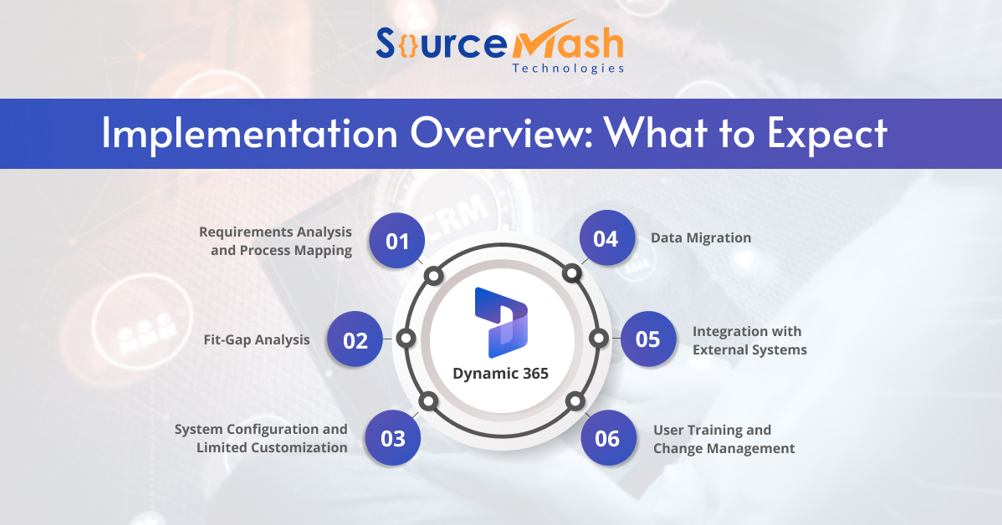
Implementing Dynamics 365 F&O is a major transformation project, not just a software installation. A typical implementation involves:
1. Requirements Analysis and Process Mapping
The project begins with a detailed analysis of business requirements across departments such as finance, supply chain, operations, and reporting. Existing processes are documented and mapped to identify how work is currently performed and where improvements are needed. This step ensures that the ERP solution supports real operational needs rather than assumptions.
2. Fit-Gap Analysis
Once requirements are defined, they are compared against standard Dynamics 365 F&O functionality. This analysis identifies:
- Fits where standard features meet business needs
- Gaps where additional configuration, extensions, or process changes may be required
The goal is to maximize the use of standard capabilities while minimizing customization, which helps reduce cost, complexity, and future upgrade risks.
3. System Configuration and Limited Customization
Dynamics 365 F&O is then configured based on approved requirements. This includes setting up organizational structures, financial dimensions, workflows, security roles, and parameters.
Customization is kept to a minimum and is typically limited to regulatory, reporting, or critical operational needs that cannot be addressed through standard configuration or extensions.
4. Data Migration
Historical and master data (such as customers, vendors, items, charts of accounts, and open transactions) is extracted from legacy systems, cleansed, validated, and migrated into Dynamics 365.
Data accuracy is critical at this stage, as poor data quality can impact system performance and user trust after go‑live.
5. Integration with External Systems
Many organizations rely on additional systems such as CRM, payroll, tax engines, banking platforms, or third-party logistics providers. Integrations are designed and tested to ensure smooth data flow and process continuity between Dynamics 365 F&O and these systems.
6. User Training and Change Management
End users are trained according to their roles and responsibilities. Training typically includes hands-on sessions, documentation, and user acceptance testing (UAT).
Change management activities help users adapt to new processes, reduce resistance, and promote system adoption across the organization.
7. Go-Live and Post-Launch Support
After final testing and readiness checks, the system goes live. Post-launch support ensures that issues are resolved quickly and that users receive assistance during the transition period. This phase is essential for stabilizing the system and maintaining business continuity.
Implementation Duration:
Most enterprise implementations of Dynamics 365 F&O take 6 to 18 months, depending on business size, process complexity, number of legal entities, level of customization, and organizational readiness.
Licensing and Cost Considerations
Dynamics 365 F&O uses a role-based user licensing model. Organizations can license Finance, Supply Chain Management, or both, with attached licenses available at a lower cost.
Overall investment typically includes:
- User licenses
- Implementation and consulting services
- Ongoing support and optimization
While it is a premium ERP solution, it is designed to replace multiple legacy systems and improve long-term operational efficiency.
Future Direction and ERP Trends
The future of Dynamics 365 Finance and Operations is moving toward:
- Deeper AI-driven automation
- Faster implementations through reusable accelerators
- Industry-specific solutions and add-ons
- Improved data governance and security
- Closer integration with Copilot and autonomous agents
These trends position D365 F&O as a continuously evolving ERP rather than a static system.
How Sourcemash Technologies Supports Dynamics 365 Finance & Operations Success?
Dynamics 365 Finance & Operations is a powerful ERP platform, but realizing its full value depends on effective implementation, integration, and ongoing optimization. Sourcemash Technologies helps organizations convert Dynamics 365 F&O capabilities into measurable business outcomes.
With deep expertise across Microsoft Dynamics 365 ERP and CRM, Sourcemash aligns finance, operations, and customer processes on a unified Microsoft platform.
Strategy‑Driven Implementation
Sourcemash takes a business‑first approach, focusing on:
- Aligning F&O with business goals and KPIs
- Standardizing and optimizing finance and supply chain processes
- Minimizing customization using native features
- Designing scalable, future‑ready architectures
This reduces risk, controls costs, and accelerates time‑to‑value.
Seamless ERP–CRM Integration
Sourcemash integrates Dynamics 365 F&O with Dynamics 365 CRM to unify:
- Order‑to‑cash and sales‑finance processes
- Procurement and vendor management
- Customer service, billing, and receivables
- Project delivery, invoicing, and revenue recognition
The result is improved visibility, customer experience, and reporting accuracy.
Ongoing Optimization and Support
Post‑go‑live services include performance tuning, feature adoption, Power Platform automation, and enhanced analytics and compliance—ensuring the system evolves with business needs.
Industry‑Focused Expertise
Experience across manufacturing, distribution, professional services, and regulated industries enables higher adoption, cleaner data, and faster ROI.
A Long‑Term Digital Platform
By combining ERP expertise, CRM integration, and Microsoft ecosystem knowledge, Sourcemash transforms Dynamics 365 F&O into a connected, intelligent platform that supports scalability, visibility, and sustained growth.
Final Thoughts
Dynamics 365 Finance and Operations is not designed for every organization. However, for businesses with complex, global, or growing operations, it provides a powerful and scalable ERP foundation.
When implemented thoughtfully, it helps unify finance and operations, improve visibility, and support long-term digital transformation. For organizations evaluating enterprise ERP platforms or planning to modernize legacy systems, Dynamics 365 Finance and Operations remains a strong strategic option.
 MOHALI - HQ
 BANGKOK
 TORONTO
 NEW YORK
 BENGALURU