#E-commerce Web Development
Salesforce and E‑commerce Integration: Complete Guide
In today’s competitive digital marketplace, businesses can no longer afford disconnected systems. Customers expect consistent experiences across websites, mobile apps, social channels, and customer support. This is where Salesforce and e‑commerce integration plays a vital role helping businesses unify data, automate operations, and deliver meaningful customer experiences.


This guide explores what Salesforce–e‑commerce integration is, why it matters, how it works, key benefits, common use cases, challenges, and best practices, giving you a clear understanding of how this integration supports modern e‑commerce growth.
Understanding Salesforce and E‑commerce Integration
Salesforce and e‑commerce integration refers to connecting an online shopping platform such as Salesforce Commerce Cloud, Shopify, Magento, or custom storefronts with Salesforce CRM and related Salesforce tools. This integration enables seamless data flow between customer touchpoints and internal systems.
The goal is to ensure that customer data, orders, inventory, marketing insights, and support interactions are centrally managed and accessible in real time.
Instead of relying on manual data transfer or working across multiple disconnected platforms, businesses gain a unified ecosystem that improves visibility, efficiency, and personalization.
Why Salesforce Integration Is Critical for E‑commerce Businesses
E‑commerce operations generate massive amounts of data from browsing behavior to purchase history and post‑sale interactions. When this data lives in separate systems, it creates gaps that affect customer experience and operational efficiency.
Salesforce helps eliminate these gaps by acting as a central intelligence hub, allowing e‑commerce businesses to:
- Maintain a 360‑degree view of customers
- Personalize shopping journeys
- Improve customer service efficiency
- Make data-driven business decisions
- Scale operations effectively
As online competition increases, businesses that leverage integrated systems have a clear advantage.
Key Salesforce Solutions Used in E‑commerce Integration
Salesforce provides multiple cloud solutions that work together to support end‑to‑end e‑commerce operations, from online selling to marketing, sales, and customer support.
Salesforce Commerce Cloud
Salesforce Commerce Cloud is a dedicated e‑commerce platform offering both B2C and B2B capabilities. It supports:
- Personalized shopping experiences
- AI-driven product recommendations
- Dynamic pricing and promotions
- Mobile‑first storefronts
When connected to CRM data, Commerce Cloud enables highly tailored customer journeys across channels.
Salesforce Sales Cloud
Sales Cloud helps sales teams access complete customer data, including profiles, purchase history, and engagement activity. In B2B e-commerce, this visibility enables sales reps to better understand buyer behavior, manage accounts, support custom pricing or contracts, and strengthen customer relationships.
Salesforce Service Cloud
Service Cloud supports post‑purchase customer service by giving support teams real‑time access to order details, returns, shipping status, and past interactions. This centralized view enables faster issue resolution, consistent omnichannel support, and improved customer satisfaction.
Salesforce Marketing Cloud
Marketing Cloud enables personalized and automated marketing campaigns based on customer behavior and ecommerce data. Businesses can run targeted email campaigns, automate customer journeys, and deliver relevant promotions using real‑time insights from shopping activity and preferences.
How Salesforce–E‑commerce Integration Works
Integration can be implemented in multiple ways depending on business needs, system complexity, and scalability requirements.
1. API-Based Integration
Most modern e‑commerce platforms and Salesforce solutions provide APIs that allow real-time data exchange. APIs are commonly used to sync:
- Customer profiles
- Orders and invoices
- Product catalogs
- Inventory data
This method offers flexibility and scalability for growing businesses.
2. Middleware and Integration Tools
Middleware platforms act as a bridge between Salesforce and the e‑commerce system. These tools manage data transformation, error handling, and scalability, making them ideal for complex integrations.
3. Native Connectors
Some e‑commerce platforms provide pre-built Salesforce connectors that simplify setup and reduce integration time. While easier to implement, they may offer limited customization.
Key Benefits of Salesforce and E‑commerce Integration
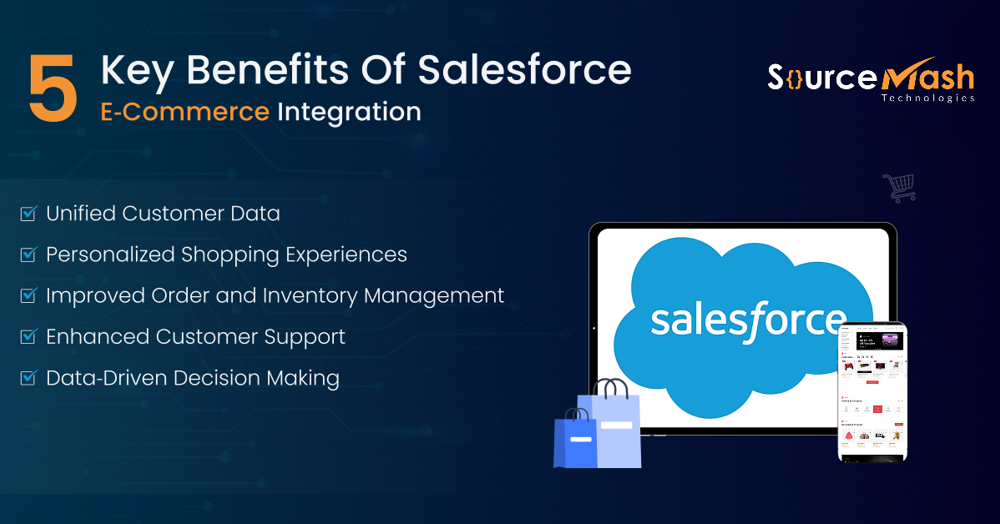
Unified Customer Data
Integration centralizes customer data across sales, marketing, and support channels. Businesses gain a complete view of each customer, including purchase history, browsing behavior, support tickets, and engagement patterns.
This unified data foundation is critical for delivering consistent and relevant customer experiences.
Personalized Shopping Experiences
With Salesforce’s customer intelligence and AI capabilities, businesses can deliver personalized recommendations, targeted promotions, and dynamic content based on real customer behavior.
Personalization increases engagement, conversion rates, and customer loyalty.
Improved Order and Inventory Management
Real-time synchronization of orders and inventory helps eliminate overselling, delays, and fulfillment errors. Operations teams can track order status, returns, and stock levels more accurately.
This visibility is especially important during high-volume sales periods.
Enhanced Customer Support
Customer support agents can access order details, payment information, and previous interactions directly from Salesforce. This reduces resolution time and improves customer satisfaction.
Integrated data also enables proactive support, such as tracking delayed shipments or recurring issues.
Data‑Driven Decision Making
Salesforce dashboards and reports provide insights into sales trends, customer behavior, campaign performance, and revenue metrics. Businesses can use these insights to optimize pricing, marketing strategies, and product offerings.
Common Use Cases of Salesforce E‑commerce Integration
B2C Online Retail
Salesforce integration helps retail brands deliver personalized shopping experiences using customer behavior and purchase data. It supports omnichannel marketing and enables responsive customer service across websites, mobile apps, email, and social media, improving engagement and loyalty.
B2B E‑commerce Platforms
For B2B businesses, Salesforce supports account‑based pricing, custom catalogs, and contract management. Sales teams gain visibility into customer purchasing behavior, enabling personalized experiences, better relationship management, and improved upselling opportunities.
Omni‑Channel Commerce
Salesforce integration ensures consistent customer experiences across all channels, including physical stores, websites, marketplaces, and mobile apps. It synchronizes customer data, inventory, orders, and promotions, enabling seamless interactions across touchpoints.
Challenges in Salesforce and E‑commerce Integration
While integration offers significant value, it also comes with challenges that businesses must address carefully.
1. Data Synchronization Complexity
Salesforce and e‑commerce platforms manage data differently, making synchronization challenging. Accurate integration requires proper data mapping, validation, error handling, and continuous monitoring. Poor synchronization can lead to incomplete, duplicate, or outdated customer and order data.
2. Customization and Scalability
Businesses with complex workflows often need custom integration logic. Without careful planning, excessive customization can increase maintenance effort and limit scalability. As transaction volumes grow, integrations must handle higher data loads without performance issues.
3. Security and Compliance
Integrated systems handle sensitive customer information, making security essential. Secure authentication, encrypted data transfer, access controls, and compliance with data protection regulations (such as GDPR) are necessary to protect data and maintain customer trust.
Best Practices for Successful Integration
To maximize value and reduce risks, businesses should follow these best practices:
- Clearly define integration objectives and success metrics
- Choose scalable integration methods that support growth
- Maintain clean, standardized data across systems
- Implement strong security and access controls
- Test integrations thoroughly before deployment
- Continuously monitor and optimize performance
Working with experienced Salesforce integration professionals can also help avoid costly implementation mistakes.
How Sourcemash Technologies Supports Salesforce and E‑commerce Integration?
Sourcemash Technologies helps businesses get the most value from Salesforce and e‑commerce integration by creating secure, flexible, and high‑performance solutions based on their needs. With experience in Salesforce CRM, Salesforce Commerce Cloud, and popular e‑commerce platforms, we help businesses bring all their digital systems together to improve customer experience and day‑to‑day operations.
We work closely with businesses to assess existing systems, define integration goals, and implement the most effective integration approach whether through API‑based integrations, middleware solutions, or native Salesforce connectors. Their integration strategies are designed to ensure real‑time data synchronization across customer profiles, orders, inventory, marketing workflows, and customer support systems.
By focusing on clean data architecture, automation, and scalability, Sourcemash helps e‑commerce brands:
- Achieve a complete 360‑degree customer view within Salesforce
- Deliver personalized shopping and marketing experiences
- Streamline order fulfillment and inventory visibility
- Enhance customer service with centralized, real‑time insights
- Future‑proof integrations for growth and evolving business needs
With a strong emphasis on security, compliance, and performance optimization, Sourcemash Technologies empowers businesses to turn Salesforce into a powerful growth engine for modern e‑commerce operations.
Conclusion
Salesforce and e‑commerce integration is no longer optional for businesses that want to remain competitive in a customer‑centric digital economy. By unifying customer data, streamlining operations, and enabling personalized experiences, Salesforce empowers e‑commerce brands to grow efficiently and sustainably.
With the right integration approach, tools, and best practices, businesses can turn Salesforce into a powerful engine that drives revenue, customer satisfaction, and long‑term success.
 MOHALI - HQ
 BANGKOK
 TORONTO
 NEW YORK
 BENGALURU